




Monika Radžiūnaitė is a young generation Lithuanian painter of exceptional style, whose work resembles an intellectual historical detective. Her artistic language is based on medieval and Renaissance culture, religious iconography and old texts, which the author boldly deconstructs and rethinks in the context of the modern world. M. Radžiūnaitė's canvases are characterized by a flat, decorative depiction, reminiscent of old manuscript miniatures or tapestries. Her works are full of irony, absurd elements and hidden cultural references. The artist explores how the meanings of symbols have changed over the centuries, and ancient truths in her paintings meet modern quotes from popular culture. This is a deep, aesthetic and at the same time provocative painting that requires the active involvement of the viewer.
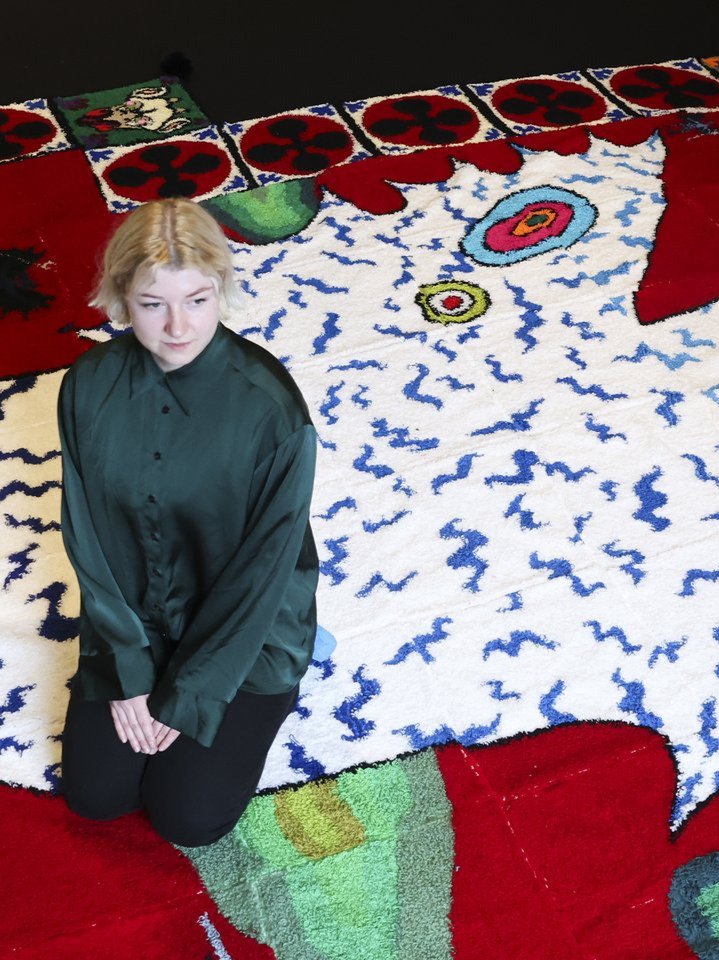
Born: 1992 in Lithuania
2019 Bachelor's degree in Painting (Vilnius Academy of Arts)
2021 Master's Degree in Painting (Vilnius Academy of Arts)
The artist has been organizing solo exhibitions since 2019 and participating in group exhibitions since 2011.
Her work is characterised by interpreting history, reviving elements of medieval and early renaissance paintings, and using cultural references in painting plots. In her paintings, Radžiūnaitė talks about foolishness and the change in cultural meanings over the course of history. Her works are based on ignorance, foolishness, and/or error. This creative strategy as a conscious state of foolishness frees the artist from the need to know the true or historical meanings of the images or the circumstances of their formation. Radžiūnaitė raises questions about the possibility of reconstructing the Middle Ages and the limitations of such possibility determined by historical circumstances. Past, present, and future are difficult to measure and understand objectively, while cultural continuity and the influence of past epochs on contemporaneity can be deconstructed ironically. Radžiūnaitė’s paintings are full of Christian iconography, symbols and stories which are usually purposely mistaken and represented in a way that is more useful or relevant to the present. According to the author, people create an environment in which they can manipulate or comfortably rely on ignorance and unawareness. In this way, she creates new meanings and contexts while also raising the question of memory as a political, cultural or religious tool.
Lithuanian